
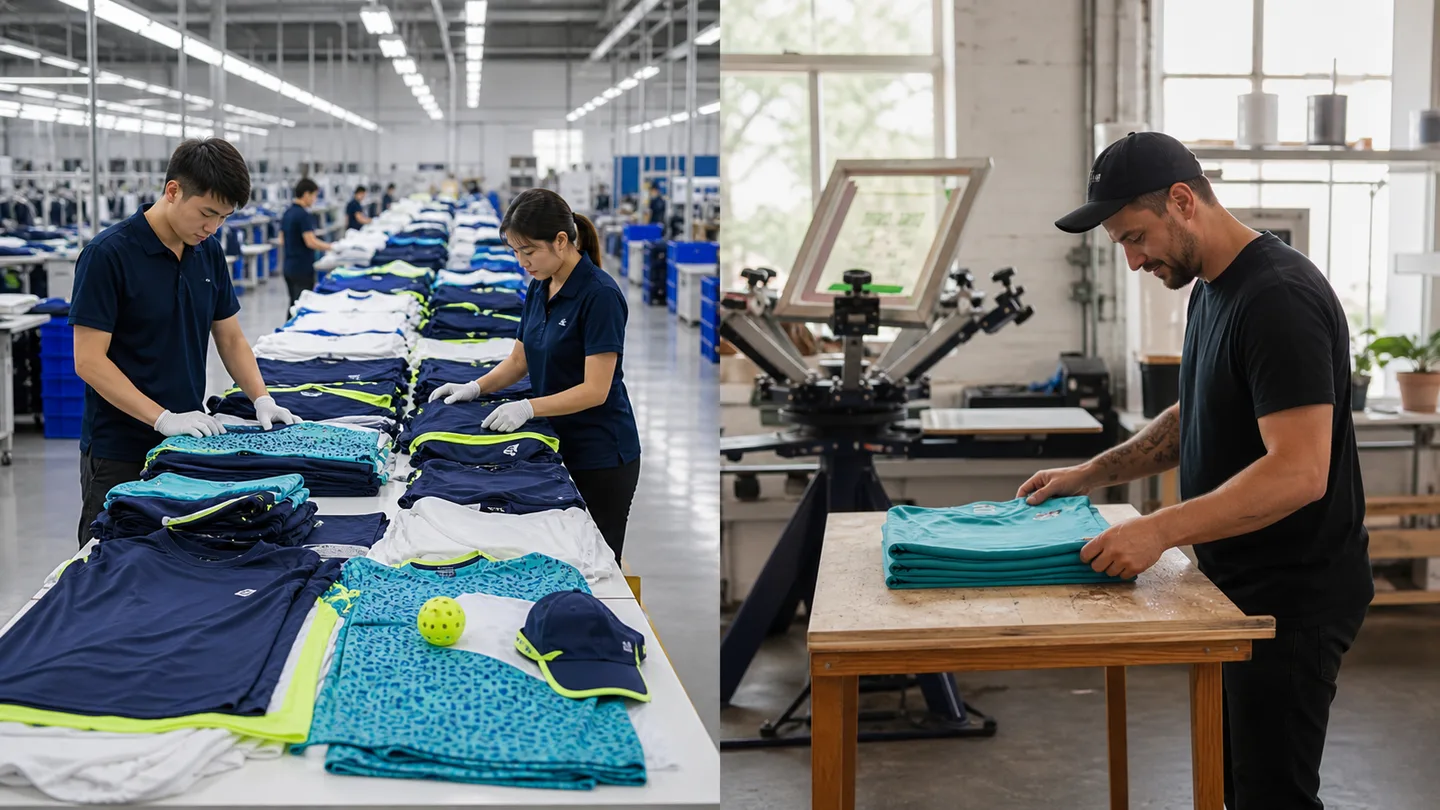
The short answer: a direct factory often becomes competitive when the order meets its production minimums, while a local print shop can be the better fit for small, urgent orders on stock garments. The useful answer depends on quantity, product specification, deadline, destination and repeat-order needs. Compare both routes against the same custom pickleball apparel brief.
Where Custom Pickleball Apparel Cost Comes From
To understand why the two options price so differently, you have to see where each one’s costs sit.
A local print shop usually decorates stocked blank garments and is set up to handle short runs, local pickup and fast collaboration. Its strongest advantages are convenience, speed and flexibility when the garment itself does not need to be developed from scratch.
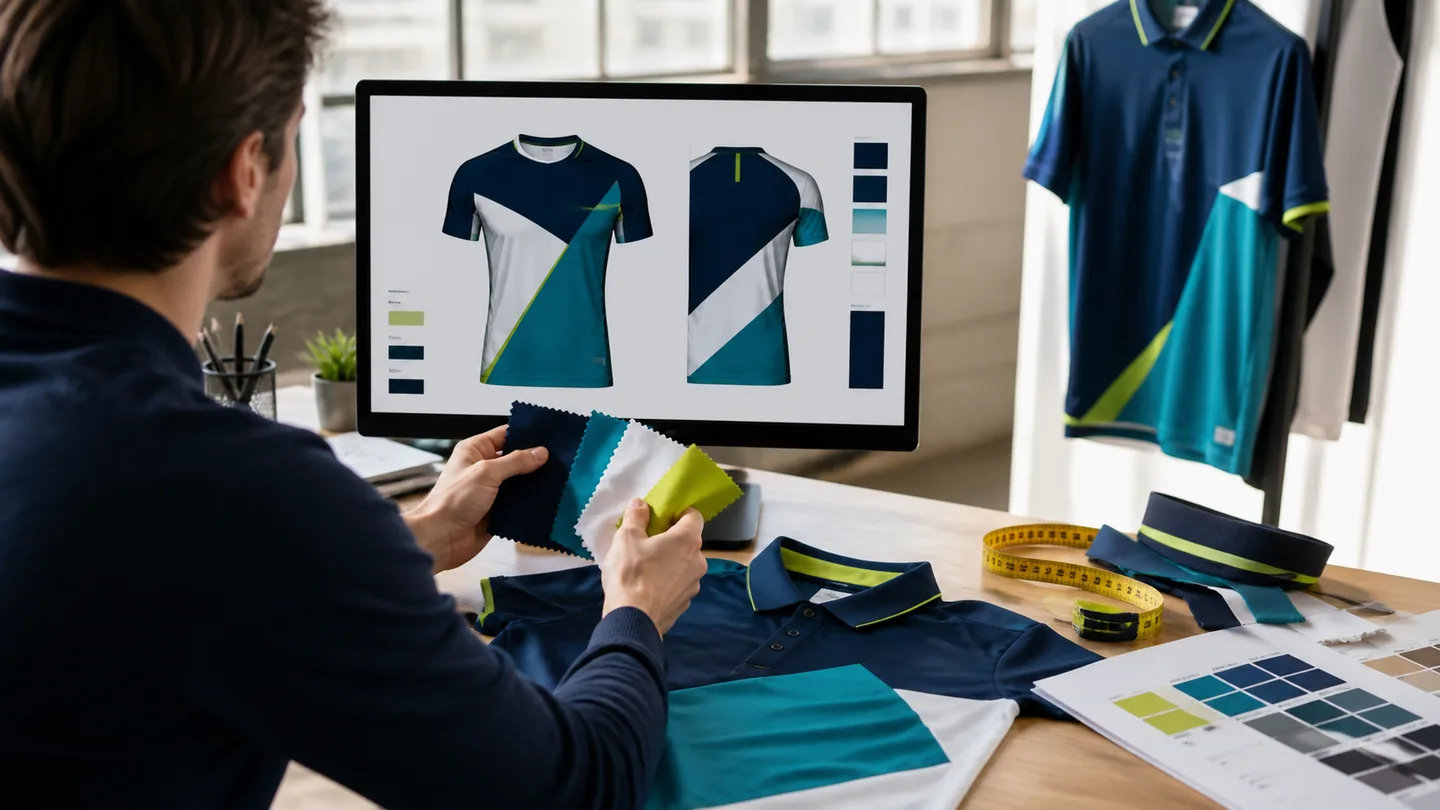
A factory develops or sources the fabric, pattern, garment and decoration as one production program. Suitable fully sublimated shirts at AX Pickleball can start from 50 pieces per design, while most polos, bottoms, headwear and cut-and-sew products start from 100 pieces per style. A factory is strongest when buyers need product-level customization and repeatable bulk production.
The question is not which source is always cheaper. It is which one produces the required result at the lowest landed cost for a defined quantity, deadline and specification. That answer comes from comparable quotes.
Direct Factory vs Local Shop, Side by Side
| Factor | Direct factory | Local print shop |
|---|---|---|
| Per-shirt cost at volume | Low – setup spread across many units | Higher – small batches, retail blank costs |
| Small orders (a handful) | Not economical; MOQ applies | Great – this is their bread and butter |
| Minimum order | 50 pieces for suitable sublimated shirts; often 100 pieces for other categories | Often lower, depending on method and blank |
| Turnaround | Weeks (sample + production + shipping) | Days for simple jobs |
| Design capability | Full-bleed sublimation, all-over prints, complex art | Usually screen print or DTG; all-over is rare |
| Consistency across a big run | High – same press line, same fabric lot | Can vary between batches |
| Custom fabric, cut, or fit | Yes – you can spec the fabric and details | Usually off-the-shelf blanks |
| Freight | Shipping costs apply, possibly international | Little to none, you’re local |
A few of these deserve more than a table row.
Why the Factory Wins at Volume
Once you’re ordering for a whole club or a tournament, the per-shirt math flips in the factory’s favor for reasons that go beyond just price.
The blank cost. A local shop is printing on retail blanks they bought from a distributor. A factory is working one or two steps closer to the source – it’s buying fabric and building shirts, not buying finished tees at markup. That gap alone accounts for a big chunk of the price difference, and it widens as quantity grows.
Setup spread over more units. Sublimation setup – the transfer paper, the press calibration, the sample – costs roughly the same whether you order 50 shirts or 500. On 50 shirts that’s a real per-shirt cost; on 500 it’s noise. Local shops have the same dynamic with screen setup, but they can’t compete on the blank cost or the production throughput, so their floor stays higher.
Consistency. A documented factory specification can control fabric, color target, print placement and construction across a bulk run. Reorders can still vary when fabric lots, components or process conditions change, so buyers should keep an approved sample and ask how the supplier manages repeat production. Local shops face similar variation when a blank style or color changes between distributor batches.
Product-level customization. A factory can develop fabric weight, stretch, pattern, trims and a custom neck label as one program. A local decorator generally works within the blank garments available from its suppliers.
Why the Local Shop Still Wins Sometimes
None of this means local shops are bad. They’re the right tool for specific jobs, and pretending otherwise is how people end up with a three-week wait for something they needed in four days.
Small orders. If you need six shirts for a new doubles team, no factory wants that order and you shouldn’t want to pay factory setup on it. A local shop will have it to you by Friday. This is the clearest case for local.
Deadlines. If your tournament is next week and you just realized nobody ordered shirts, a factory’s sample-plus-production-plus-shipping timeline will not save you. Local can. Rush jobs are a local shop’s specialty.
Physical collaboration. If you want to stand at a counter, feel the blank shirts, and point at the color you mean, that’s a local-shop experience. With a factory you’re working over email, specs, and a shipped sample – which works fine, but it’s a different rhythm. Some buyers just prefer the in-person process, and for a small order that preference costs little.
One-offs and tests. If you’re trying out a design or a name-and-number idea before committing to a big order, a local shop can print a test shirt cheaply and immediately. That’s a smart way to iterate before you spend real money at volume.
The Hidden Costs Nobody Quotes
Both sides have costs that don’t show up in the headline price, and you should know them before you compare.
With a factory, the obvious hidden cost is freight, especially if the factory is overseas. Shipping a few hundred shirts isn’t free, and it takes time. There’s also the sample cost and the lead time – you’re paying in calendar days even if the per-shirt price is low. Rush it and you pay more. None of these are scams; they’re just line items you need to ask about up front so the comparison is fair.
With a local shop, the hidden cost is usually the per-color and per-location fees that appear when you go from “one-color chest logo” to “three-color front plus back plus sleeves.” Screen printing charges multiply fast with design complexity, and a local shop’s all-in price for a complex design can quietly approach or exceed a factory’s all-over sublimation price – for a shirt that’s on a cheaper retail blank.
The other hidden cost on both sides is mistakes. A botched order is expensive no matter who makes it, but a factory that runs a pre-production sample is set up to catch problems before 300 shirts exist, while a local shop rushing a deadline might not have that step. Ask both how they handle approval and what happens if the run comes out wrong.
How to Decide for Your Situation
Run through these questions and the answer usually falls out.
How many pieces, and in which category? A very small decorated-blank order often suits a local shop. A suitable sublimated shirt program may fit a factory from 50 pieces, while polos, bottoms and other cut-and-sew categories often start from 100 pieces. In every overlap, compare landed quotes that use the same specification.
When do you need them? Weeks or months out → factory. Days out → local. If you have time, the factory’s lower per-shirt cost is free money. If you don’t, the local shop’s speed is the whole point.
How custom is the product? A simple logo on a stock tee may suit either source. Custom fabric, pattern, fit, labels or coordinated multi-product development points toward a factory. Some local specialists also offer sublimation, so ask about their actual equipment and garment construction rather than assuming from the business type.
Do they need to match now and later? If repeatability matters, choose the supplier that documents the fabric, color target, artwork, placement and construction and can explain how reorders are controlled. That supplier may be a factory or a capable local specialist.
Is the budget measured per shirt or as a landed total? A small group may accept a higher unit price to avoid factory minimums and freight. A larger program should compare the total delivered cost, sample process and risk of unusable inventory.
The Real Answer
Direct factory versus local print shop is a choice between two production models. Local shops often fit small, urgent or one-off decorated-blank orders. Factories fit programs that meet category minimums and need fabric, pattern, construction, labeling or coordinated bulk production.
Factory development fits buyers who meet the relevant product MOQ, have time for sampling and need more than decoration on a stock blank. Review AX Pickleball’s custom pickleball apparel manufacturing capabilities, or contact the team with your product, quantity, deadline and destination. If a local route fits the specification better, that should be clear before either side starts development.